

Home India Australia Economic Cooperation and Trade Agreement [ECTA]
We will discuss about the recently announced India Australia Economic Cooperation and Trade Agreement, widely known as India Australia ECTA.
This agreement covers a variety of topics such as duty free access to Indian export products, cooperation in services, student work visas, opportunities for Indian chefs and yoga instructors, etc.
As per Union Minister Shri Piyush Goyal, It is expected that the current bilateral trade of 31 Billion USD may reach 45 to 50 Billion Dollars in the coming 5 to 6 years.
In this page we will look at this agreement from the perspective of Indian goods exporters and see how this trade agreement can benefit them to expand their business in Australia. You will get all the information in this page like - Is the Agreement beneficial for you? Which products are eligible? What are the rules or origin? How can you apply for CoO under this Free Trade Agreement? Where to apply? What are the documents required? What are the obligations on part of the exporter? Etc. So let’s get started.
We all know that FTA gives preferential tariff access to Indian Export products in the Importing country.
One such FTA is recently announced India-Australia ECTA. Ind-AUS ECTA was signed in April 2022, and has become operational since 29th December 2022.
So why is this FTA so important? - Over 96% of India’s exports to Australia by value will be getting duty free access under the India Australia Economic Cooperation and Trade Agreement immediately from the start date of this agreement. And remaining product lines getting duty free access gradually in the coming 5 years
Most Textiles and Apparel, Some agricultural, fisheries products, leather, footwear, furniture, sports goods, jewellery, machinery, electrical goods, railway wagons, also select pharmaceutical and medical goods will be among the biggest beneficiaries of this trade agreement.
Australia on the other hand is a supplier of raw materials and intermediates, minerals and things like that, which are very useful for the Indian Industry, because if our raw materials are cheaper then the final product is also cost competitive in the world markets. So this agreement is a win-win situation for both the countries.
The list of all such products HS code wise is given in ANNEX 2A - Schedule of Australia. The link of this PDF file is shared below -
The list of all such products HS code wise is given in ANNEX 2A - Schedule of Australia. The link of this PDF file is shared below -
[Link for ANNEX 2A - Schedule of Australia - https://commerce.gov.in/wp-content/uploads/2022/06/02A-2-Schedule-Australia.pdf]
This list shows HS Code, Product Description, base rate and the Staging category. The Staging category is of two types i.e. A & B5
Staging Category A means there will be 0% Import duty in Australia from 29th December 2022 itself.
Staging Category B5 means there will be 0% Import Duty in Australia at the end of 5 years, and every year the import duty will be reduced in equal installments.
Let us understand this by way of an example, please see the table below -
| HS Code | Description | Base rate | Staging category |
| 6302.12.10 | Curtains | 5% | A |
| 7208.10.00 | FLAT-ROLLED PRODUCTS OF IRON OR NON ALLOY STEEL, -In coils, not further worked than hot-rolled, with patterns in relief | 5% | B5 |
In this table it can be seen that “Curtains”, which currently has an Import duty of 5%, will immediately become 0 from 29th December 2022.
And “Flat rolled products” under chapter 7208 which currently has an Import duty of 5%, will be reduced in equal installments i.e. 4%, 3%, 2% and so on and it will eventually become zero by the end of 5 years.
You will get all the information in the below video like - Is the Agreement beneficial for you? Which products are eligible? What are the rules or origin? How can you apply for CoO under this Free Trade Agreement? Where to apply? What are the documents required? What are the obligations on the part of the exporter? Etc. So Let’s get started.
So the rules of origin is a very important section. A product will be considered of Indian origin only if 1. It is wholly obtained or Produced in India or 2. Produced entirely in India using non-originating materials [i.e. imported materials]
We will understand each By way of an Example:
Wholly obtained in India means the products that are entirely grown in India or produced using 100% Indian raw materials. A common example of such products would be fruits & vegetables that are grown in India.
So the 1st criteria is pretty simple and clear.
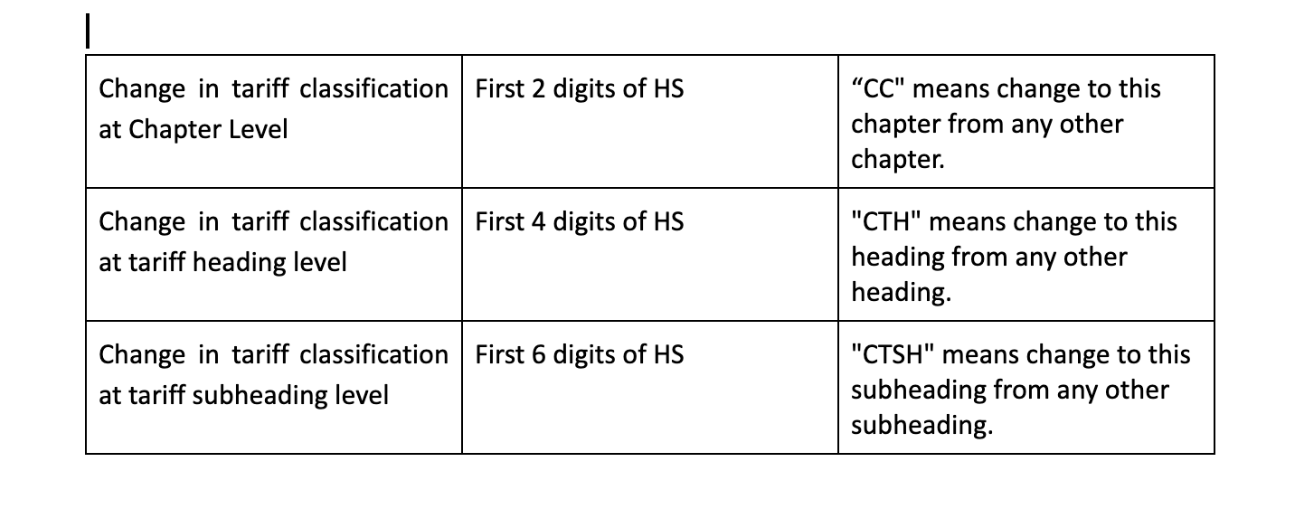
Regarding the 2 Criteria, a product will be considered as originating from India if it undergoes change in tariff classification at Chapter Level [CC] i.e. First 2 digits of HS / tariff heading level [CTH] i.e. First 4 digits / tariff subheading level [CTSH] i.e. First 6 digits
AND/OR
The QVC shall be calculated using one of the following methods:
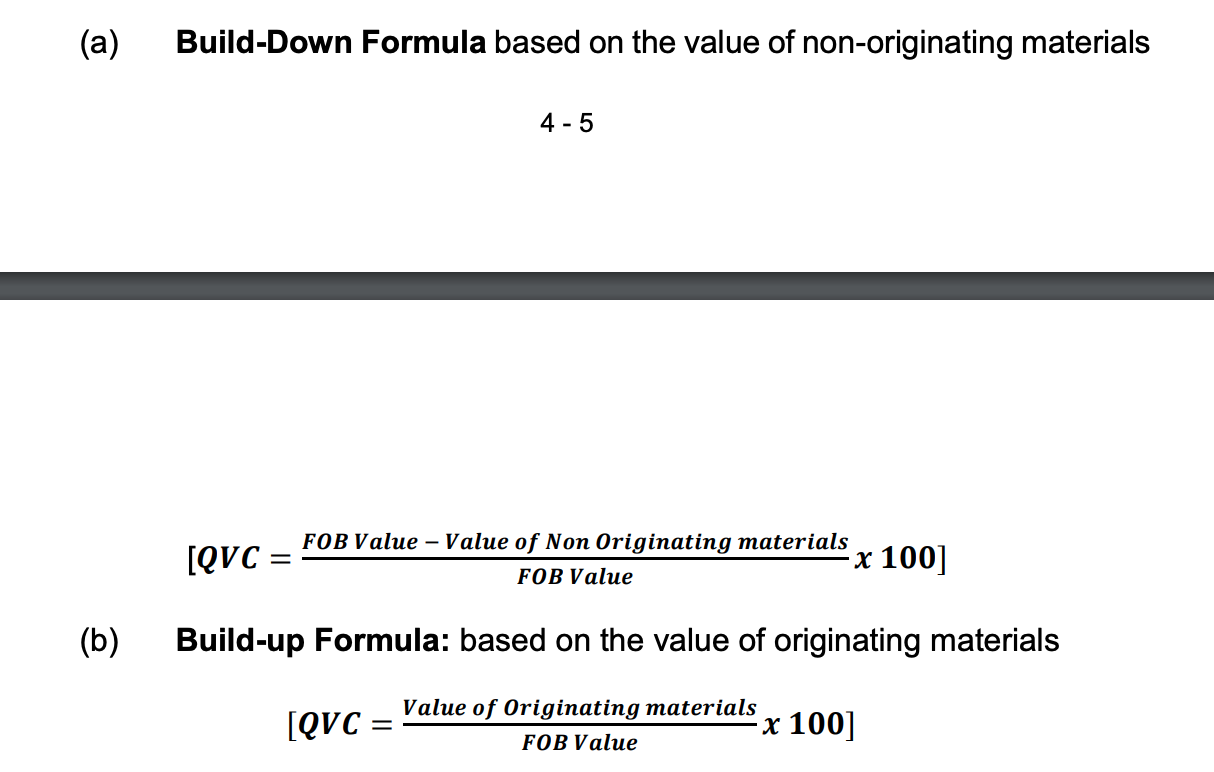
So, in short if your export product is not wholly obtained, then you need to check the Product specific rules as per Annex 4B and determine if your export product will be eligible for the India Australia ECTA benefit or not.
So next let us discuss the Product specific Rules of origin.
Let us understand these rules by way of 3 Examples
Example 1 –
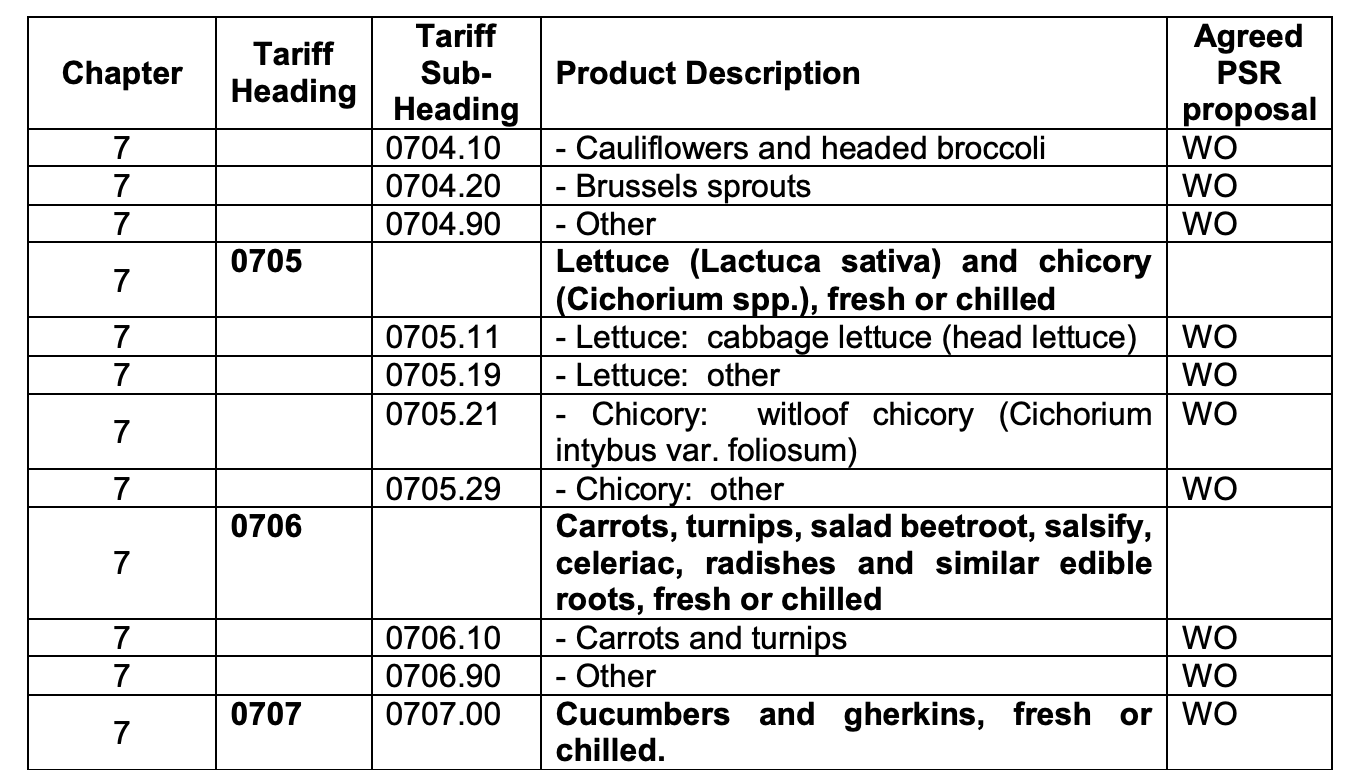
The Image shows that for the above products to qualify for the duty free access benefit, it should be Wholly Obtained [WO] in India.
Example 2 –
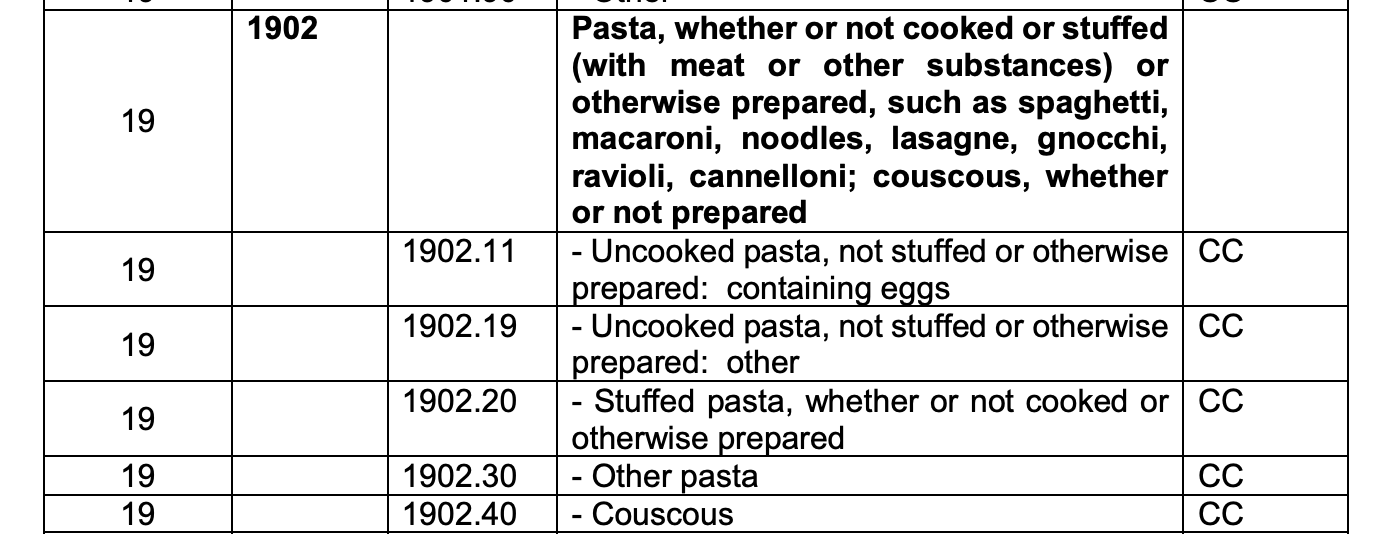
So in this example the export product i.e. Pasta of various types will qualify for the ECTA benefits only if it has undergone a change in CC. It means that all non-originating materials used in the production of the good have undergone a change in tariff classification at the two digit level; i.e. First 2 digits of all imported Raw materials [Non-originating materials] are different from First 2 digits of the final export product.
Example 3 –
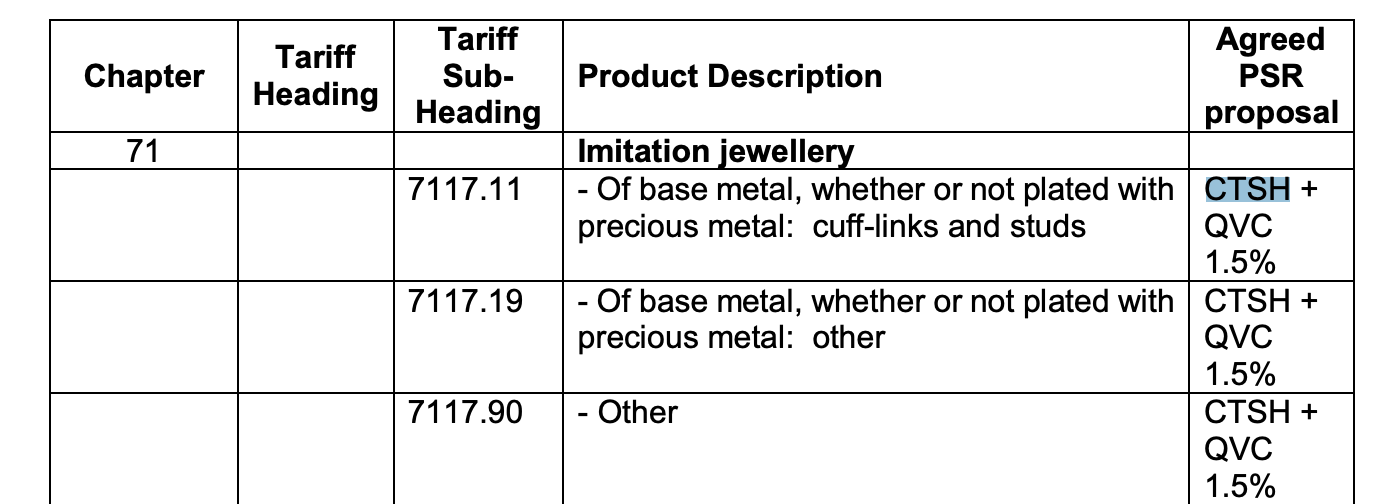
So in this example the export product i.e. Imitation Jewellery will qualify for the ECTA benefit if it satisfies both the criteria’s i.e. CTSH + QVC 1.5% i.e. First 6 digits of all imported Raw materials [Non-originating materials] are different from First 6 digits of the final export product AND QVC of not less than 1.5% using the build-up method or build-down method.
It should be noted that, the PSR of all the products are not notified yet, this will be an ongoing process. So if your export items are not covered under the Product specific rule of origin, then to determine whether the goods are origination from India, a General Rule as per the below Image should be used:
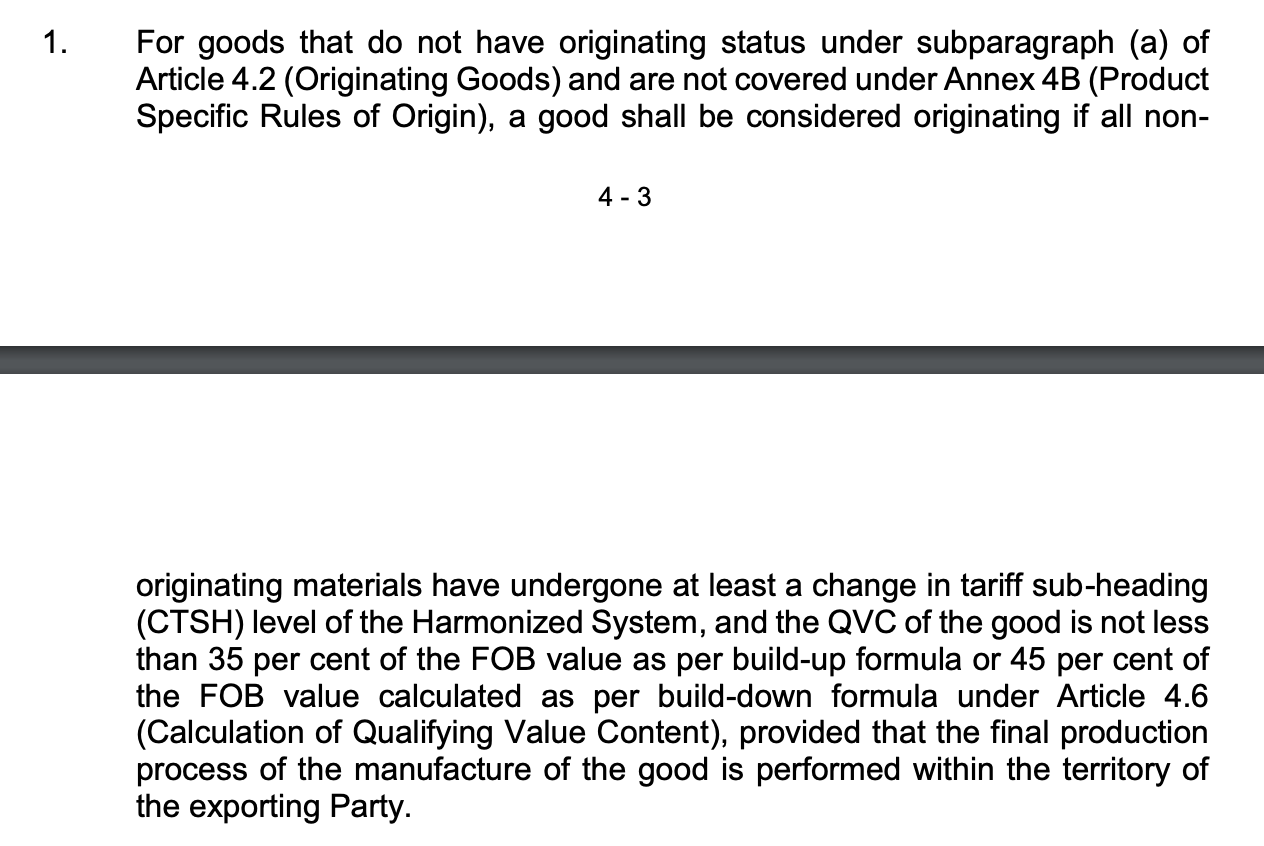
If there are many export items in the Invoice then VA for each export item should be calculated separately. Maybe it is possible that some of your items are not fulfilling the PSR criteria, then in those cases you have to mention that in your documents & ECTA benefits for those products should not be taken.
Also, In order to calculate the QVC value correctly Please refer to Sub para 5, 6, 7 & 8 of Article 4.6 under Chapter 4 - Rules of origin.
Now, many times it may happen that, you use 5 to 6 non originating materials to make a final product. But one or two of your non originating materials are not able to satisfy the criteria of change in tariff Classification rule i.e. CC or CTH or CTSH.
In such cases Article 4.8 under Chapter 4 - Rules of origin can be of help. It states that,
For Export Products falling under Chapters except 50 to 63, such goods will be considered as originating if the value of all such non originating materials is less than 10% of the FOB Value of Export Goods.
And for all the Export products falling under Chapters 50 to 63, such goods shall be considered as originating if the total weight of all such non originating material does not exceed 10 percent of the total weight of that export good.

Application for CoO under CEPA is to be done on the CoO common digital platform. It is a compulsory online process.
Application should be filed within 5 days from the date of export.
Common set of documents required are:
1. Digital Signature
2. Exports Invoice copy
3. Packing List
4. Bill of Lading
5. Shipping Bill.
Once the application is done the CoO is issued within one to two working days.
We at KK Aequitas Group, are a team of DGFT & Customs Experts having a rich experience of 10+ Years in Exim Consultancy & International Logistics [Freight Forwarding]. With our vast knowledge and experience in this field we can represent your case for all the activities pertaining to the Country of Origin and get it cleared in a hassle free manner.
So do get in touch with us for any of your requirements and our team will be happy to help you.

© 2024 K.K. Aequitas - Developed by - Advert India
© 2024 K.K. Aequitas - Developed by - Advert India